
Information: CANADIAN COUNTER-TARIFF RESPONSE TO SECTION 338
This information is provided by Peacock Tariff Consulting.
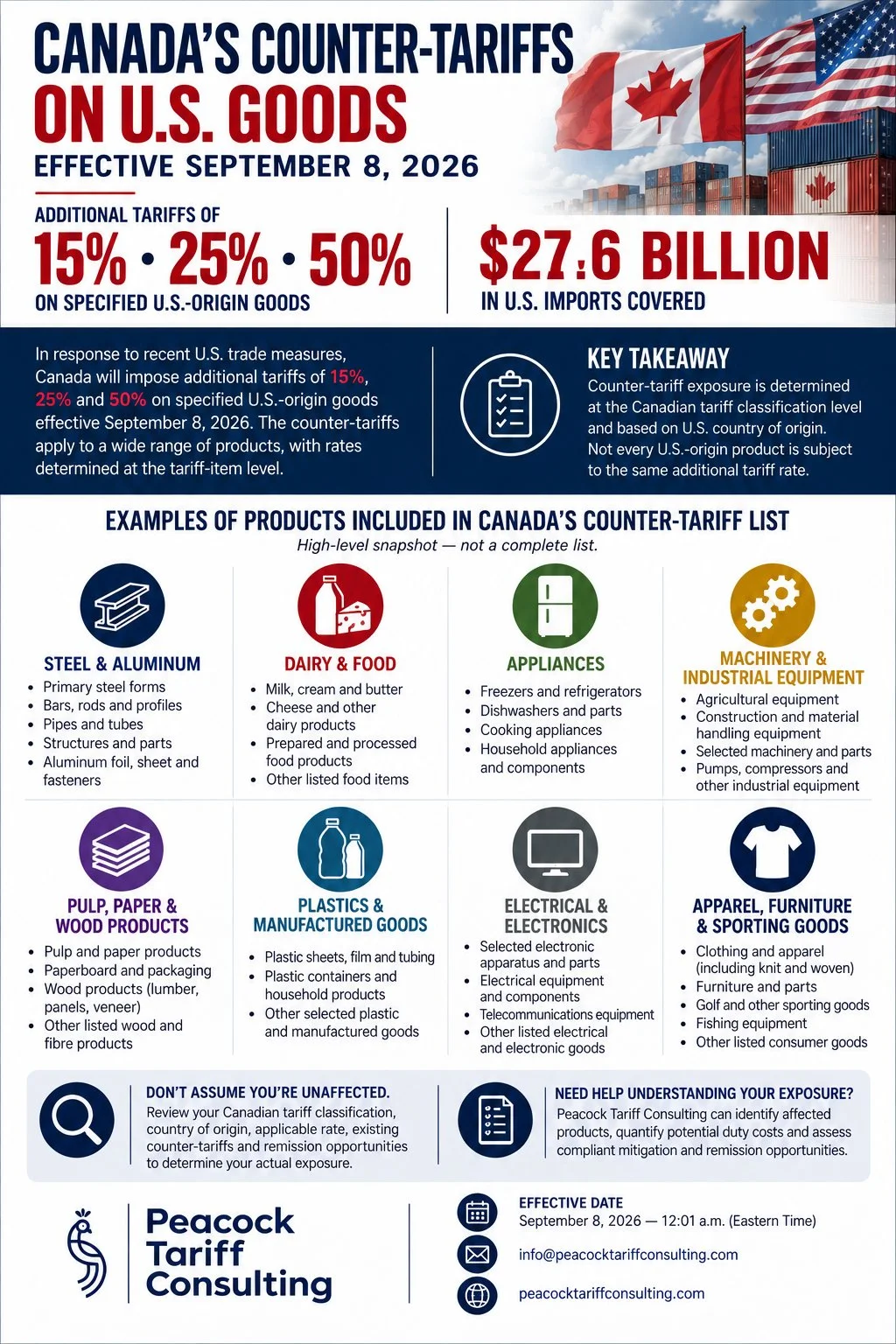
Canada implemented a new round of counter-tariffs on U.S.-origin goods effective September 8, 2026, in response to the United States’ Section 338 tariffs on Canadian products.
The measures cover approximately $27.6 billion in U.S. imports and apply additional duties of 15%, 25% or 50% depending on the product.
When did the new Canadian counter-tariffs take effect?
The new counter-tariffs took effect at 12:01 a.m. on September 8, 2026.
Businesses importing affected U.S.-origin goods into Canada should review entries occurring on or after the effective date to determine whether the additional tariff applies.
What products are affected?
The counter-tariffs cover a broad range of U.S.-origin products. Key sectors include:
Steel and aluminum products
Dairy products
Appliances
Agricultural equipment
Plastics
Electronics
Pulp and paper products
Various consumer and industrial goods
The applicable rate depends on the specific Canadian tariff classification. Not every product within these general categories is necessarily subject to the counter-tariff. Businesses should confirm their individual tariff items against the current Government of Canada list.
Are all affected products subject to a 50% tariff?
No. The counter-tariff rate varies by product. Depending on the tariff item, the additional duty may be 15%, 25% or 50%. For certain steel and aluminum products already subject to Canadian counter-tariffs, the rate has increased from 25% to 50%.
How do I know whether my product is affected?
The counter-tariffs are applied according to the product’s Canadian tariff classification. Importers should identify the applicable Canadian tariff classification and compare it against the Government of Canada’s current list of products subject to counter-tariffs. A general product description is not enough to determine whether the tariff applies.
Does the tariff apply to anything shipped from the United States?
No. The measures generally target U.S.-origin goods, not simply goods shipped from or purchased from a U.S. supplier. A product shipped from the United States may have a different country of origin. Likewise, goods manufactured in the United States using foreign materials may require a more detailed origin analysis. Country of origin should therefore be reviewed separately from the country of export.
Does CUSMA protect U.S.-origin goods from the counter-tariffs?
Not automatically. A product may qualify for preferential tariff treatment under CUSMA and still be subject to Canada's applicable countermeasure. Businesses should not assume that a valid CUSMA certification means the additional Canadian tariff does not apply.
Who pays the counter-tariff?
The Canadian importer of record is generally responsible for duties owing when the goods are imported. However, the ultimate commercial cost may depend on contracts, Incoterms and arrangements between suppliers, importers and customers. Businesses should review both their customs exposure and their commercial agreements.
Do Canada's previous counter-tariffs still apply?
Some do. The September 8 measures are part of Canada's broader response to U.S. trade actions. Other existing Canadian countermeasures, including measures affecting certain U.S. automotive products, continue to apply. Businesses should therefore review their complete tariff exposure rather than looking only at the September 8 list.
Are there exemptions or relief available?
Potential relief depends on the product and circumstances of the importation. Businesses facing significant tariff exposure should review whether any existing exclusions, remission provisions or other relief mechanisms may apply. Where no existing relief is available, businesses may also need to consider whether there are grounds to pursue a remission request.
Can we change our HS code to avoid the counter-tariff?
Only if another classification is legally correct. Businesses should not change tariff classifications simply because their current tariff item appears on the counter-tariff list. However, a significant new tariff is a good reason to validate existing classifications. Classification errors that previously had little financial impact can become considerably more expensive when an additional 15%, 25% or 50% duty is introduced.
What should Canadian businesses do now?
Canadian importers should review:
Products currently sourced from the United States
Canadian tariff classifications
Country of origin
Applicable counter-tariff rates
Existing CUSMA treatment
Existing Canadian countermeasures
Import volumes and expected tariff costs
Supplier contracts and Incoterms
Alternative sourcing opportunities
Potential tariff relief or remission options
Businesses with significant U.S. purchasing should also consider quantifying their expected tariff exposure so that the financial impact can be incorporated into purchasing and pricing decisions.
What if we are unsure whether our products are affected?
The counter-tariffs are product-specific, so the most reliable approach is to review the tariff classification and origin of each affected product.
Peacock Tariff Consulting can assist businesses with classification reviews, tariff exposure assessments, origin analysis and available tariff mitigation or relief options.
peacocktariffconsulting.com | info@peacocktariffconsulting.com